
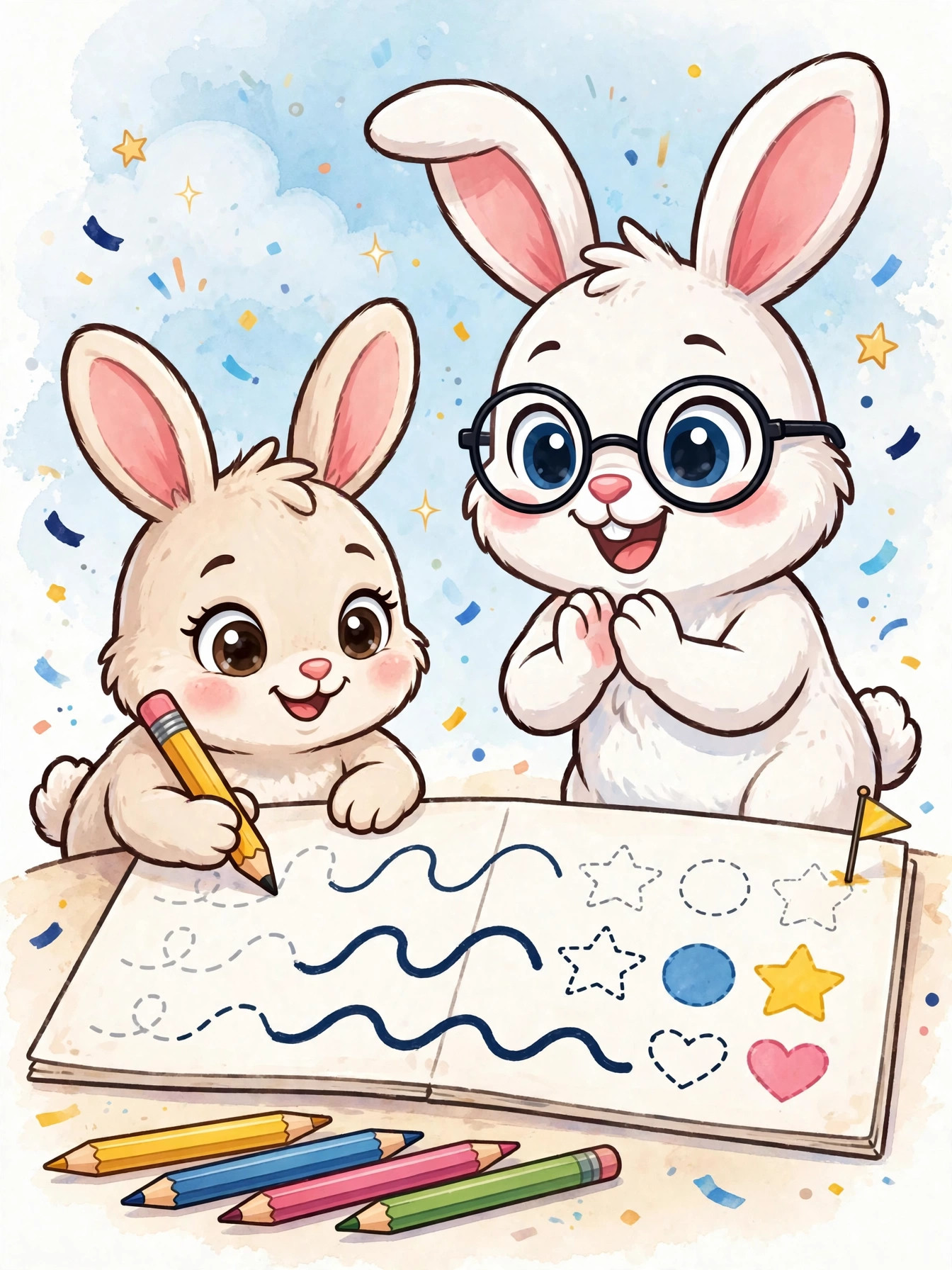
Nobody learns to write by writing. Long before a child forms their first independent letter, they pass through a series of smaller skills, each one preparing the hand and the eye for the next. When writing feels hard for a child, the problem is almost never the letters themselves. It is usually a skipped step earlier in the chain. This guide walks through the progression in order, so you can spot where your child is, and give them practice that fits that stage instead of the stage you wish they were at.
Step one: control of the tool, around age 3
The first writing skill is simply steering a pencil where the child wants it to go. Straight lines come first, then wavy lines, zigzags, curves, and loops, each a little harder to control than the last. This is pure pencil control work, and it belongs on big paper with wide paths and zero pressure about letters. Our line tracing worksheets are organised exactly this way, in groups from straight lines through zigzags, waves, curves, and loops, so a child can climb the ladder one rung at a time.
Step two: shapes, around ages 3 to 4
Shapes are letters in disguise. A circle is the body of a, o, and d. A triangle hides inside A. Crosses, squares, and semicircles each rehearse a movement that handwriting will reuse. A child who can trace the main shapes steadily has quietly practised most of the strokes the alphabet requires. Both of our shape sets live on the shapes worksheets hub, from simple shape tracing with colouring through to pages of twelve dashed shapes for serious repetition.
Step three: letters and numbers, around ages 4 to 5
Now the strokes join into symbols. Tracing letters with a start point and a direction to follow teaches the movement pattern of each letter, and repetition moves that pattern from the eyes into the hand. Numbers follow the same path. The key at this stage is support that fades: fully dotted letters first, then letters with fewer guides, then a model letter beside an empty line. Our letter tracing worksheets collection gathers every tracing set on the site, from basic letter tracing to formation practice with stroke order arrows, so you can match the support level to the child.
Step four: the most important word, their name, around ages 4 to 6
Ask a five year old what word they most want to write, and it is never “cat”. It is their name. Name writing is where tracing becomes personal, and motivation does the heavy lifting that drills cannot. A name a child can write goes on every drawing, every card, and every school book, and it is usually the first word written fluently and proudly. Our free name tracing worksheet generator lets you type any name and print a sheet of tracing lines made from it, with as many practice lines as you choose, which makes it easy to give this step the repetition it deserves without writing the name out by hand yourself.
Step five: copying and independent writing, around ages 5 to 6
The final steps remove the path entirely. First the child copies a letter or word written beside them, then writes from memory, and finally writes words they have chosen themselves. Copying matters more than it looks: it teaches spacing, sizing, and checking your own work against a model, which are the skills that turn letter formation into real writing.
What to do when a child stalls
Stalling at a step almost always means the step before it needs more time, not that the current step needs more pressure. A child whose letters collapse should go back to shapes. A child whose shapes wobble should go back to lines and loops. Moving down the ladder feels like a retreat, but it is how hands actually catch up, and children usually climb back up faster than they came down.
The short version
Lines, shapes, letters and numbers, their name, then copying and free writing. Five steps, in that order, with support that fades as the hand grows sure. Follow the sequence, respect a stall as information rather than failure, and writing arrives as the natural end of the road instead of a wall at the start of it.