
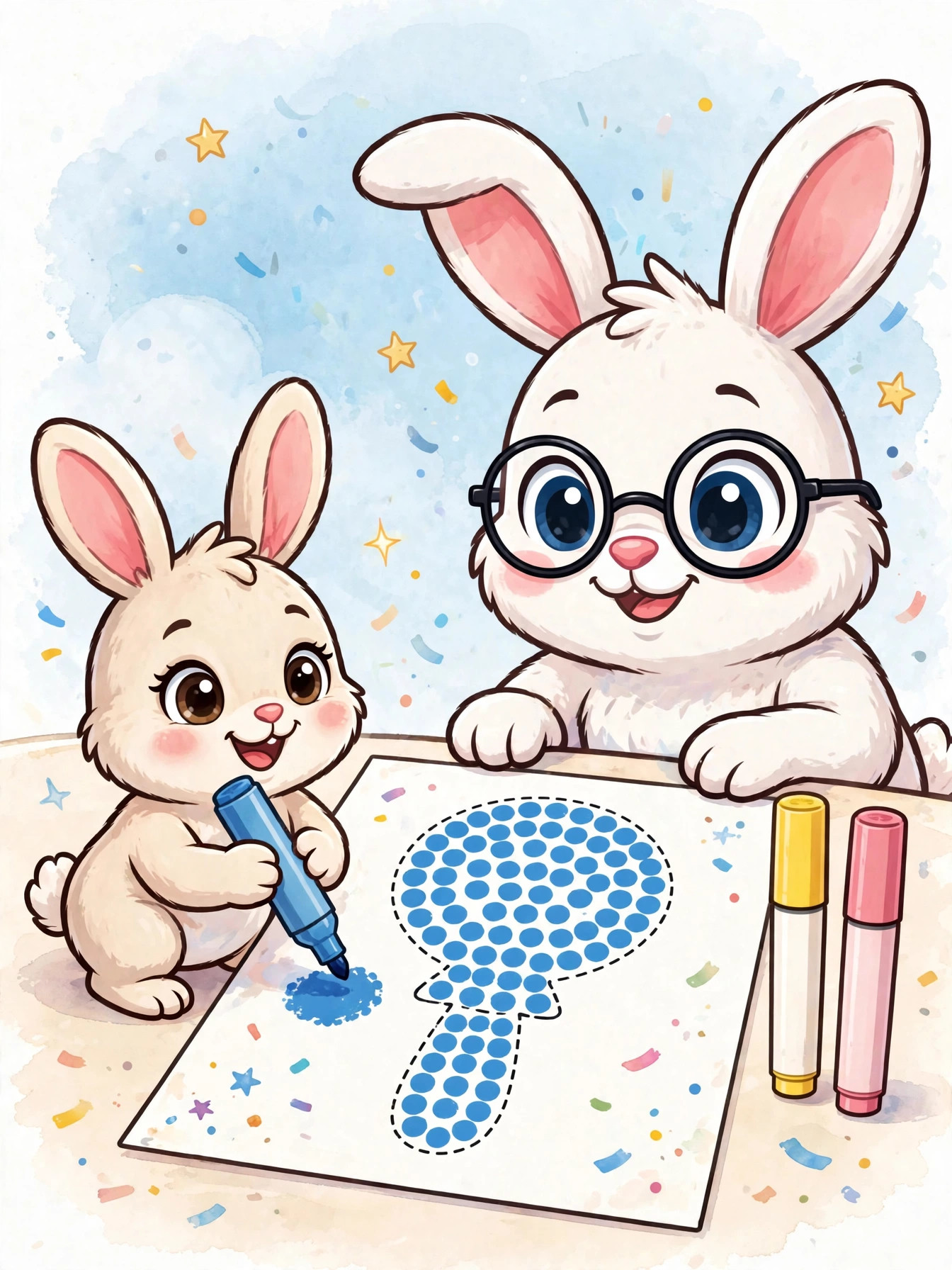
Dot markers, also called daubers or bingo dabbers, are the chunky bottles with a sponge tip that stamp a perfect coloured circle with one press. For preschoolers they are close to magic: no brush to control, no paint pot to spill, and a satisfying dot every single time. Dot marker worksheets are built around that circle, with letters, numbers, and pictures drawn as outlines of empty dots waiting to be filled. This guide covers how to use them well, what children actually learn from them, and what to do if you do not own a single marker.
How a dot marker session works
Set up is half the craft. Put a tray or a sheet of newspaper under the page, because enthusiastic dabbing travels. Show your child how to press straight down and lift straight up, rather than scrubbing, which tears paper and floods the dot. One press per circle is the goal. Then let them work through the page at their own pace, naming the letter or number as each shape fills in.
For a first session, a single large letter or number is the right size of task. Our alphabet dot marker worksheets give one big letter per page, built entirely from dot circles, so a child can finish a whole letter in one sitting and see it appear dot by dot. The matching dot marker number worksheets do the same for the numbers 0 to 20, each surrounded by a frame of small circles carrying the number to dab as well.
What children are actually learning
Dabbing looks like play, and it is, but four real skills are being trained. Hand strength and control come first: pressing a marker takes a firm, graded squeeze, and lifting cleanly takes control, both of which feed pencil grip development. Hand and eye coordination follows, because every dot must land inside its circle. Third comes early academics, since the shapes being filled are letters and numbers, and children absorb their forms while filling them far more willingly than by drilling flashcards. Fourth is task completion: a dot page has a clear finish line, and finishing builds the attention span that longer school tasks will need.
No markers? Six substitutes that work just as well
Dot markers are inexpensive, but you may not have them the day your child wants to dab. The worksheets work with anything that makes a circle or fills one.
- Cotton buds dipped in paint make neat smaller dots and add fine motor challenge.
- Round stickers fill the circles precisely, and peeling them is excellent finger work.
- Bingo chips or counters placed on each circle turn the page into a reusable activity that never runs out.
- Pom poms dabbed with a clothespin give the same press and lift motion with a grip bonus.
- Finger painting one dot per fingertip is messy, joyful, and completely valid.
- Ordinary crayons or markers work too: colouring each circle in is slower, but trains pencil control even more than dabbing.
Tips that save your sanity
Choose washable markers, and treat that word as non-negotiable with under fives. Print dot pages on the thickest paper your printer accepts, because a soaked page tears and disappoints. Work one page at a time and keep the rest of the set out of sight, so finishing feels like an achievement rather than a queue. And when a dot lands outside its circle, say nothing at all. Accuracy comes from the next fifty dots, not from correction on the first five.
The short version
Press down, lift up, one dot per circle, and let the letter or number appear. Dot marker work builds grip strength, coordination, and early letter and number recognition in a format children ask for again. You will find the letter and number sets, along with tracing and cut and paste practice, in our fine motor worksheets collection, all free to print as often as a page gets loved to pieces.