
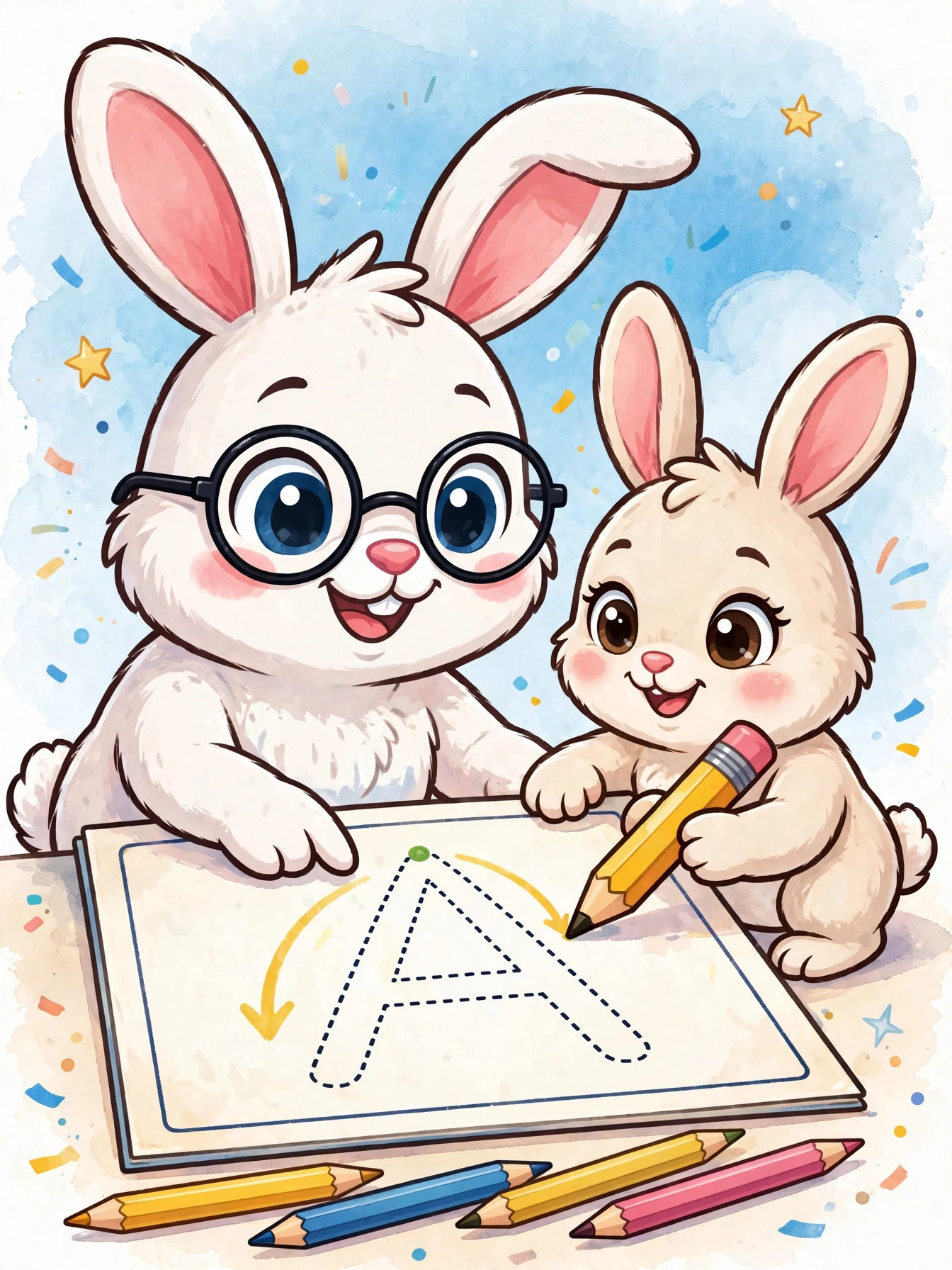
Letter formation is the skill of making each letter the right way, starting in the right place, moving in the right direction, and lifting the pencil at the right moments. It sounds like a small thing, but it is the foundation of all handwriting. A child who forms letters correctly from the start writes faster, tires less, and produces work that teachers can read. A child who invents their own way of making letters often has to unlearn it later, which is far harder than learning it properly the first time.
The good news is that letter formation is very teachable. It follows patterns, it improves quickly with short regular practice, and most children enjoy it when the steps are small and the successes come often.
Start with the strokes, not the alphabet
Every letter is built from a small set of strokes: straight lines down, lines across, curves, circles, and diagonals. Before asking a child to write a whole letter, let them master the strokes on their own. Vertical and horizontal lines come first, usually around age three. Curves and circles follow, and diagonals are the last to arrive, which is why letters like A, K, and W are genuinely harder than letters like E, F, and L.
This is also why the alphabet order is not the best teaching order. Grouping letters by how they are made works much better. Start with the straight line letters, I, L, T, E, F, and H. Move to the curve family, C, O, G, and Q. Then letters that combine lines and curves, such as B, D, P, and R, and save the diagonal letters, A, K, M, N, V, W, X, Y, and Z, for when the hand is ready.
The three cues that make formation stick
Children remember letter formation best when they hear it, see it, and feel it at the same time. Three simple cues cover all three.
First, a start dot. Most formation mistakes are really starting point mistakes. A letter begun in the wrong place forces the pencil into awkward movements. A small dot showing where the pencil lands first removes the guesswork.
Second, numbered arrows for the stroke order. Letters are made of two or three separate strokes, and the order matters. Arrows that show stroke one, stroke two, and stroke three turn a confusing shape into a short set of instructions a child can follow without help.
Third, short verbal cues spoken aloud. Simple phrases like “down, across, across” for E, or “around, and back up, and down” for a, give the hand a rhythm. Say the cue while the child traces, and within a few sessions most children say it themselves as they write.
A simple session that works
Keep formation practice short, around ten minutes, and frequent, ideally most days. Long sessions produce tired hands and sloppy strokes, which practice the wrong movements.
Begin with one letter only. Show the letter large, name its strokes, and trace it together in the air with big arm movements. Then let the child trace the letter on paper, starting with large versions where the path is wide and forgiving. As the tracing grows steadier, the letters shrink toward normal writing size. Finish with a few attempts at writing the letter without a guide, and praise the best one together. Ending on the independent attempt matters, because the goal is always writing without support.
Our uppercase letter formation worksheets are built around exactly this method, with colour coded model letters, start dots, and rows that fade from full tracing support to independent writing. The matching lowercase letter formation worksheets follow the same pattern for the small letters, which children usually meet a little later.
Uppercase first, or lowercase first
Schools differ on this, and both orders can work. Uppercase letters are mostly straight lines and simple curves, they are all the same height, and children meet them everywhere in books and signs, so they are the easier starting point for most three and four year olds. Lowercase letters matter more for real reading and writing, since most text is lowercase, but they include tricky lookalikes such as b and d, and letters that sit in three different zones on the line. A practical path is uppercase first for confidence, lowercase soon after for reading, and plenty of tracing support for both. You can browse the full range in our letter tracing worksheets collection.
Mistakes that are normal, and the one to watch
Reversals are the mistake parents worry about most. Writing b for d, or flipping S and Z, is completely normal up to about age seven, because young brains are still learning that orientation changes meaning, which is a new idea after years of learning that a cup is a cup from any angle. Reversals fade with reading practice and gentle correction.
The habit worth correcting early is not reversal but sequence: a child who consistently starts letters at the bottom, or draws a circle in two halves, is building a movement pattern that will slow their writing for years. That is what start dots and stroke arrows exist to prevent, and it is much easier to guide at age four than to retrain at age eight.
The short version
Teach strokes before letters, group letters by how they are made, and give every letter a start dot, a stroke order, and a spoken cue. Practice little and often, fade the support as confidence grows, and correct movement habits early while letting reversals resolve themselves. Do that, and letter formation stops being a struggle and becomes what it should be, the quiet foundation under everything your child will ever write.